


The Celt The Roman And The Saxon
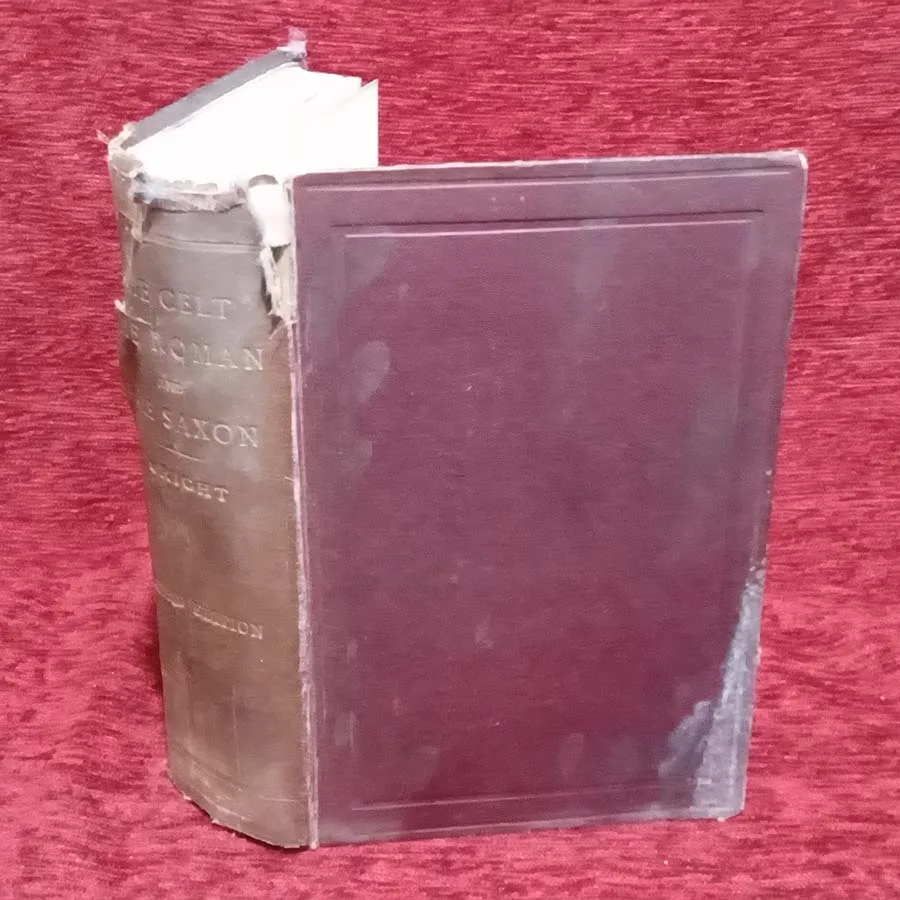
Publisher: Trubner and Co
Format: Hardback
ISBN: none
Some books set out to tell history. The Celt, The Roman, and The Saxon arrives from 1875 with the far grander intention of explaining how Britain became Britain by way of invasion, settlement, cultural collision and the long, untidy business of one people leaving traces for the next. It belongs to that magnificent nineteenth-century tradition of historical writing in which scholarship still felt faintly heroic and titles were perfectly willing to encompass entire civilisations in a single confident sweep.
Written by Thomas Wright and published by Trübner and Co., this is exactly the sort of Victorian volume that makes one feel the past was once approached with a mixture of seriousness, curiosity and tremendous narrative appetite. The title alone is a small masterpiece of historical compression: three peoples, one island, centuries of upheaval, and the tacit promise that if you sit down with the book long enough, the whole thing may begin to make sense. Which is really all one can ask of history, short of a time machine and a better grasp of Latin.
What gives the book its enduring charm is that it comes from an age deeply interested in origins. Nineteenth-century scholars loved asking how modern nations had been assembled, and Britain offered a particularly crowded answer. Here were Celts, then Romans, then Saxons, all leaving marks on the land, the language, the customs and the imagination. Wright’s subject is therefore not just succession but layering: the way one civilisation settles over another, the way roads outlast empires, the way names, ruins, habits and institutions endure after the people who made them have vanished into history’s long administrative backlog.
There is something wonderfully Victorian about the confidence of such a project. Modern historians, with admirable caution, tend to explain that everything is more complicated than it looks. Wright, by contrast, belongs to that earlier breed of scholar prepared to stride into the deep past and organise it for the reader with grave conviction. Even where later scholarship has refined, corrected or complicated the picture, the book retains the full appeal of an age that believed knowledge should be pursued boldly and set down with proper seriousness.
And what a subject it is. Britain’s past has always been a gloriously contested thing: forts and roads, tribes and legions, monasteries and kingdoms, place-names and burial mounds, all the stubborn evidence of peoples arriving, ruling, resisting, adapting and disappearing. Books like this are fascinating because they remind us that history is not merely dates but sediment. The Celt, the Roman and the Saxon are not just categories in a title; they are successive layers in the making of a country still arguing with itself centuries later.
There is also a gentle irony in the title’s neatness. “The Celt, The Roman, and The Saxon” sounds so orderly, as though these three groups arrived politely one after another, filed their paperwork and handed over the island in reasonable condition. The actual history, naturally, was a little less well behaved. That contrast is part of the pleasure. Victorian historical books often offer a calm front to deeply unruly material, and one reads them partly for their information and partly for the spectacle of nineteenth-century intellectual authority trying to impose dignified structure on a thoroughly untidy past.
This 1875 copy has exactly the sort of hard-earned character one hopes for in an old historical volume. It is in Fair condition, and while the book was rather moth-eaten, the important point is that a repair has been made to the inner hinge, which was structural, and it is now quite sound. That is no small thing. A book like this deserves continued life as a readable object, not a collapsing relic. The repair has clearly been about preservation rather than disguise, giving the volume back its usefulness while allowing it to keep all the age and atmosphere one expects from a survivor of this vintage.
In truth, the wear suits it. A pristine copy would be handsome, certainly, but a slightly battle-worn history of Britain’s invasions and cultural upheavals feels oddly appropriate. This is a book about peoples arriving, things breaking, structures being remade and continuity somehow surviving. A restored hinge and a little evidence of damage only make the parallel more pleasing. The volume has, in its own way, endured a small version of the history it describes.
For the modern reader, The Celt, The Roman, and The Saxon offers several pleasures at once. It is a work of historical interpretation, a Victorian artifact, and a reminder of how earlier generations imagined the making of Britain. It will appeal to readers of early British history, collectors of nineteenth-century scholarship, lovers of antiquarian books, and anyone who enjoys volumes that look as though they have spent serious time in serious rooms.
In short, this 1875 Trübner and Co. edition of The Celt, The Roman, and The Saxon is a deeply characterful old history book: ambitious in scope, rich in period flavour, and still full of intellectual energy. In Fair condition, with a structural inner hinge repair and now quite sound despite moth damage, it remains a fine Crappy Old Books survivor — a Victorian attempt to explain the making of Britain, housed in a book that has plainly survived a little history of its own.
Keep browsing: See more History books Other books by Thomas Wright
